Thursday, 19 January 2012

Brahmi Grantha Script Family and Cross Graftings


There's a couple of  possible error in this diagram.
It shows Thai and Burmese as being descended from Pali scripts and doesnt show Khmer Mon or Cham.
Te trouble with using the tree modle is tha tits great for showing divergence changes that are new branches but it doesnt show fusion, joinings and graftings.

The first Indian traders seemed to have  used and introduced both Nagari and Brahmi derived scripts.

Some scholars tend to presume Nagari and Sanskrit were the priamry models for scribes but take a look at this next image.


This is Grantha script. Remind you of anything? The curly letters of Tamil and Thai and other scripts?

Just as Indian religions like  Hinduism and Buddhism  Mahayana and later Theravada influenced South East Asian culture so did more than one script influence and change the development of writing systems.

More recent research including rock inscriptions and other artifacts shows the branching pattern seems to be more like this

Brahmi Grantha than an early introduction into Champa of Sankrit followed by a separate develpoment of a Grantha derived local script for writing Cham in the second centuries A.D.

A similar event in the Khmer realms a bit later. AD 629.

Another separate early introduction of Brahmi / Grantha into the Mon realms that covered southern Thailnad and Burma.

Both Old Mon and Old Khmer scripts influenced the later Thai and Lao scripts.

More evidence in the next post!

Tuesday, 17 January 2012

Grantha and SE Asian Scripts


Ever wondered where those curly letters in Thai and Burmese and other South Asian scripts come from?

This is Grantha a Southern Indian script ancestral to Tamil and Mon, Khmer, Lao, and even that Balinese script I posted about earlier.

Okay there's lotsof articles on Wikipedia and other stuff you cna Google but I'm going to translate that into a short explanation that hopefully you dont need to know about palaeography to make sense of?

Before Devenagari developed there was a script in India called Brahmi.

Scripts like languages diverge. They branch and bud. In the south of India Grantha developed and then Pallava and other forms and the forms that developed were more cursive, curly and curvy.

Why?

I suspect partly cos the stone used for inscriptions and temple building was harder stone like granite but also they scribes needed a script that could be written on materials like palm leaves.

Papermaking had not yet been introduced and paper was still an expensive imported luxury.

Yes people really did write on palm leaves.

One of the major trading ports on the south eastern coast on India was Madras where ships departed to journey to places like the Mon realms of Dvarati and Thaton in what's now Burma and Thailand and further away to Champa now southern Vietname and Funan a Khmer realm that traded with China.

And these places were where writing first appeared in South East Asia.

More on this next time!

Sunday, 15 January 2012

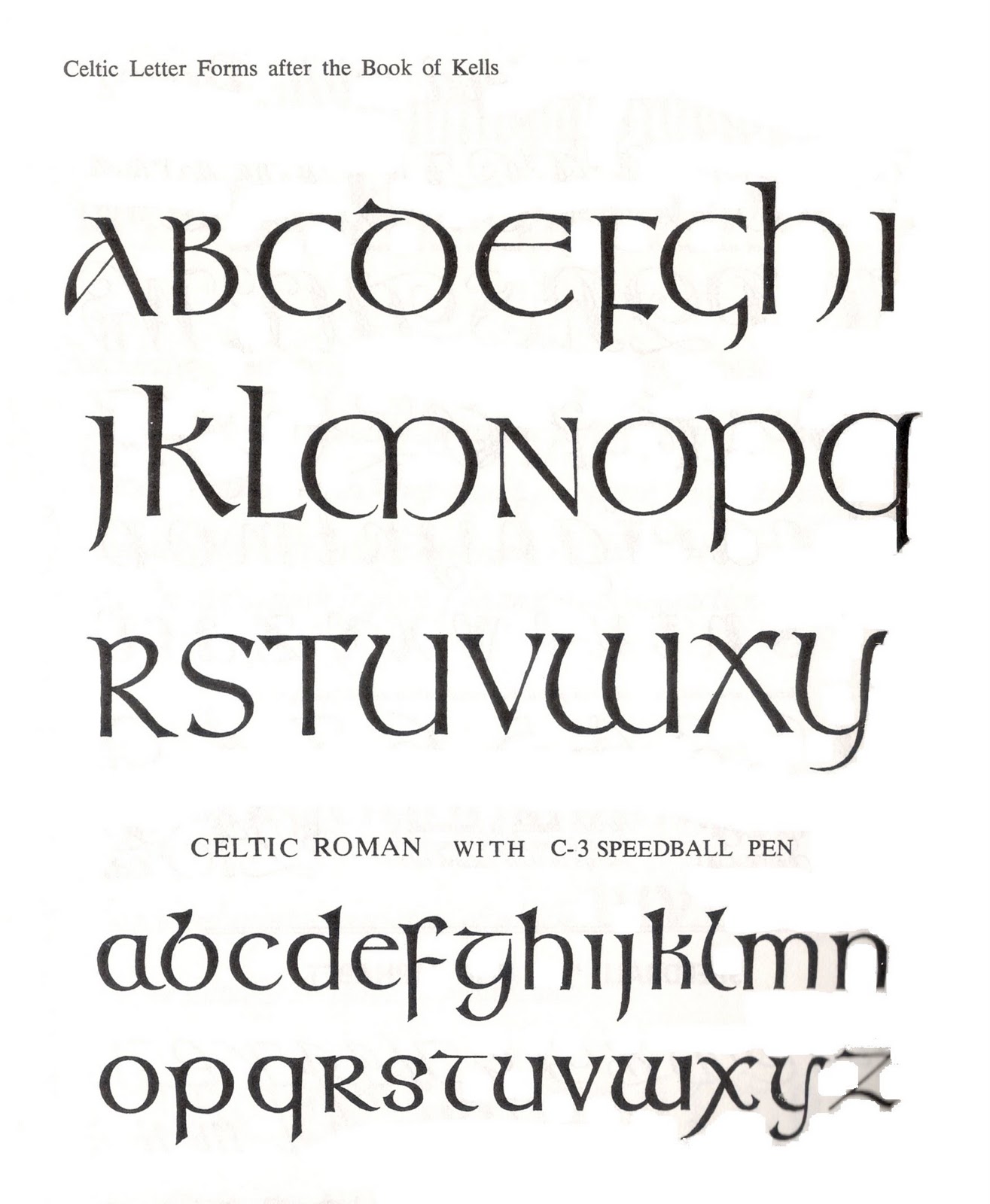
Book of Kells Letter Forms


#bookofkells #uncial #celtic #letterforms


One final example also from a noteworthy text the famous SPEEDBALL TEXTBOOK for Pen and Brush Lettering. I have the 20th edition from the 1970s and I think its up to about the 30th by now?

Even if you don't do your own calligraphy the Speedball textbook is worth looking at.

I still have a set of Speedball steel nibs which I rarely use but cherish!

Please support this blog via PayPal.me/JulieVaux


Wednesday, 11 January 2012

3 examples of Insular scripts


It's interesting to see these 2 variations derived from insular half uncial but with perhaps more carolingian influence? My diagram was based on and modified from an illustration in the Calligrapher's Bible which I've reviewd in a prior blog.

Thursday, 5 January 2012

A Celtic Font Logo

Here's an exaple of my own work using a Celtic font.I added drop shadow to the edges .

Hecate's Wolf is a reference to the Mackenziee warsong in the Emberverse novels of alternate history by S.M. Stirling

Sunday, 1 January 2012

The Calligrapher's Bible

I want to tell you about a great research resource for calligraphy and typography.


THE CALLIGRAPHERS BIBLE

100 Complete Alphabets and
How to Draw Them

David Harris

Why? Well it was very helpful while I was researching this series of blogs and its a great book.
It compares ancient prototypes with the modern calligraphy hands derived from them and many of the 100 ABCs in this book are also the starting point of many well known modern typefaces!

More images next time and meanwhile whether you are an admirer or creator of calligraphy and fonts or a typographer or graphic design do consider taking a look at this book?

Tuesday, 27 December 2011